Inspiration - and why I'll tell you something different every time you ask what my art is about
Updated: Mar 30
I've been asked many times about the inspiration that informs my work, and honestly, I don't think I've ever given the same answer.
Because the thing is with inspiration is that it doesn't move in straight lines. It's a meandering hulk of a beast that morphs and shape-shifts and takes you to all the unexpected places before you realise that, in fact, you're not quite sure if it was ever really there at all.
And the thing is with visual art is that you can bring in multiple influences, stories and inspiration in ways that are disperate, nuanced, subtle, conflicting and make it look coherent. It's what I love about art - the way it can help you make sense of things that really don't make sense in a logical and linear way. But it makes it very very hard to talk about in a way that feels logical or sensible.
So instead of trying to squash 'inspiration' awkwardly into a box that's too small (it's not a cat, after all), I thought I'd tell you a few stories that can give some clues, and some pictures that can help to illustrate. Perhaps by the end of this post you'll be as confused as me.
Grief as a creative prompt
I made my first floral installation in my last year of university. I was grappling with relationships coming to an end, the dispersion of the life that I knew and a romance that I couldn't fully reconcile myself with. The rose, to me, felt like a conflicted symbol. It was supposed to symbolise love that lasted forever, and yet, as it wilted on my windowsill it felt so fragile and so fleeting. Using the dried petals to make a new - albeit also fleeting - reality helped me to navigate the sense of loss and upheaval that I was feeling.
When my dad died a number of years later, it was these same symbols that I returned to. I needed to create something beautiful when everything felt so broken - and flowers, with their fleeting beauty, came back into my focus. In these flowers I was able to create a new landscape which, although dead and fragmented, held on to some of that beauty, and allowed me to see that there was wonder in the world still.

There's always Time
I'm fascinated by time. What even is it? When I was young I imagined that reality was just layers of time, with everything happening all at once, all of the time... And that time was actually just a force like gravity that was pulling you through these layers in a direction that you had no control over. I could visualise myself falling through time, and wonder how I could angle my body through the fall to land in a different place.
When I grew up I studied books on the history and philosophy of time, and I learned that my curiosity was well founded - still nobody seems to know quite what it is or how it works, and yet, we take it so much for granted.
Learning about the history of time led me to understand how the clock has changed our perception of time; the it became less relative and more universal - and increasingly atomised. Our relationship with time used to come from the land: from the seasons; from the light; from the bird song. The growing distance between time and place through clock time seemed to allow us to think globally and concurrently lose our grounding in place.
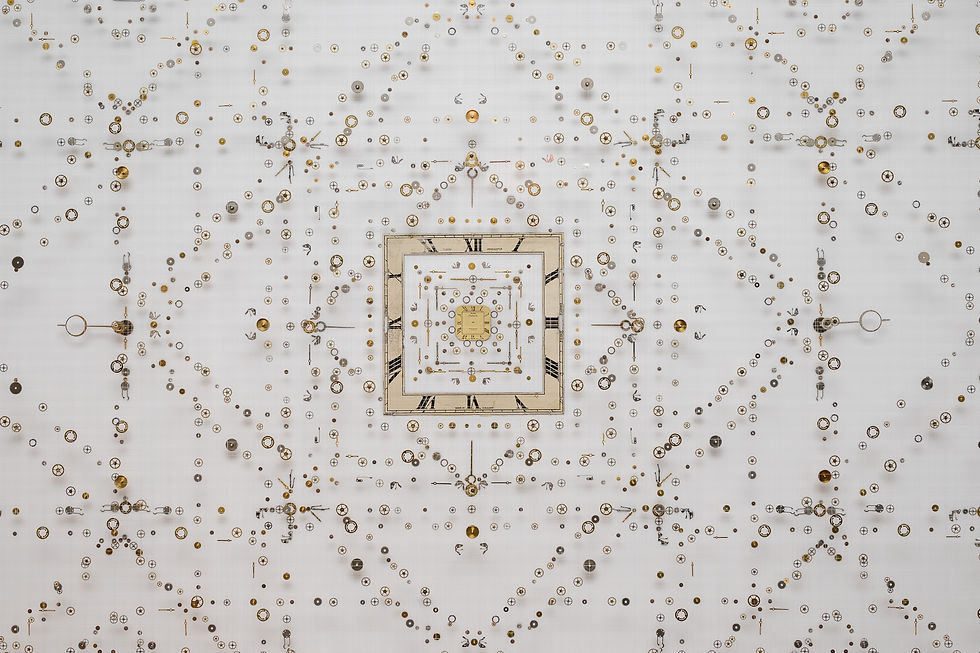
In a very quiet rebellion against this 'clock' time, my dad would never wear a watch. On his bookshelves there sat an old ornate clock whose hands didn't move once in all of my memory. Instead, he would look at the sun and know the time to within about 10 minutes accuracy. (My mum recently told me that he was reliably 20 minutes late to meet her, so perhaps it didn't stand him in such good stead after all).
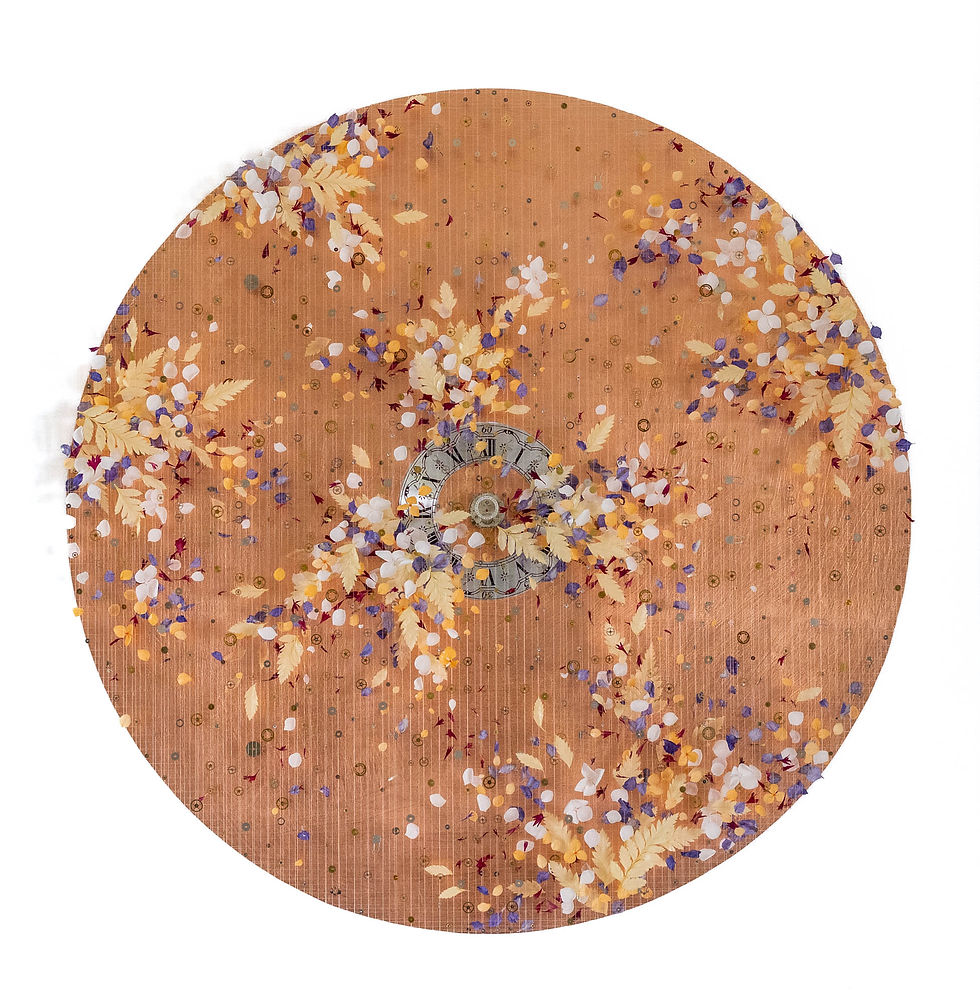
But after my dad's death, the silent, unticking clock felt like a connection to him. It allowed me to access him in a way that sometimes I couldn't otherwise, and the quiet, laborious and meditative process of making works with watch parts allowed me to escape time completely for a while; it was a pause in my head whilst the world kept spinning.
The Wilds of Home
My parents split up when I was eight. I couldn't really understand it at the time. But I do know that it left me with an underlying skepticism about love. In my mind, love became transactional. The best strategy for a lasting relationship was to become indispensable: to be the best partner possible; to accommodate every whim. I was lucky to find myself in relationships with good men. It took me a long time to come back to myself.
But the idea of 'home' became transactional too, and in many ways, I've struggled to reconcile this issue much more than love. 'Home' was no longer permanent or secure. At best, it was a place to rest before moving on. My heart yearned for the thing that I had lost - not just through the break up of the family home, but through the breaking up of the narratives of permanence that seem so indisputable with youth. I longed to feel safe, secure, free, fearless.
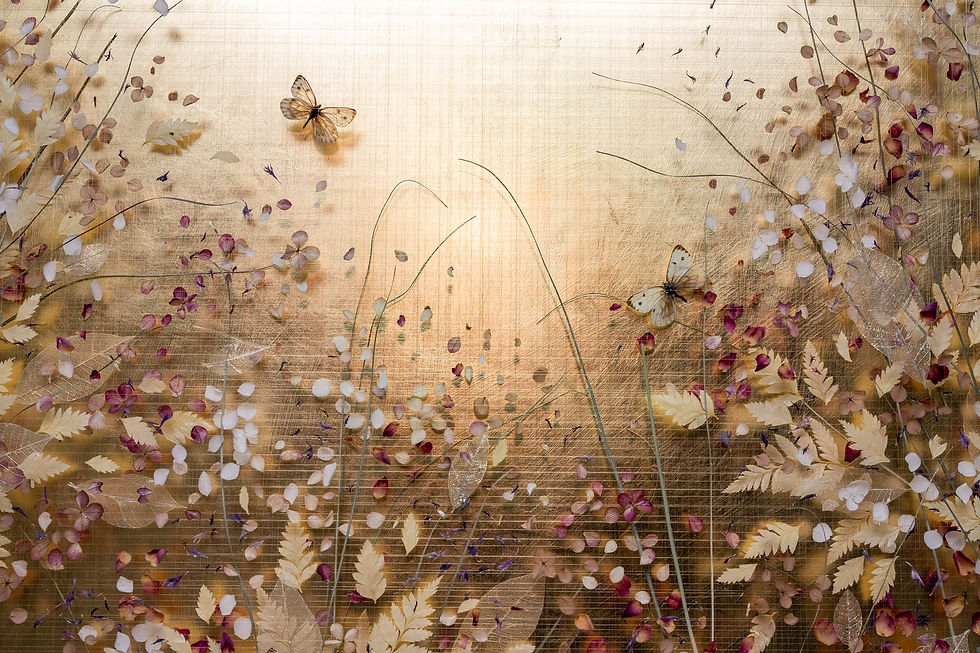
For me, the place that I feel this most is in the wild landscapes. I remember holidays in France, running through fields and butterflies springing up through the grasses. I remember the joy of finding stag beetles fighting in the garden. I remember lying in the long grasses with my best friend talking about all the things we loved, sun shining on our faces. I remember my mum seeming happiest when she was tending to flowers in the garden. I remember the way the sun shines through fresh new leaves in the forest in Spring.
So my works are a return to all these feelings, trying to capture the sense of a place and time that was fleeting and making it permanent. It's home-building where my own home had fallen.
Interwoven Threads
My mum could have been an artist. She loves to draw, and make and learn. I was a good, quiet kid, so when my mum was on (yet another) art course, she'd take me along and pop me down with pencils and paper in the corner. And when I was older, I was allowed to get involved. I learned to weave, to make paper, to make beaded jewellery. And I joined the Young Embroiderer's Guild (yes, I was that kid).
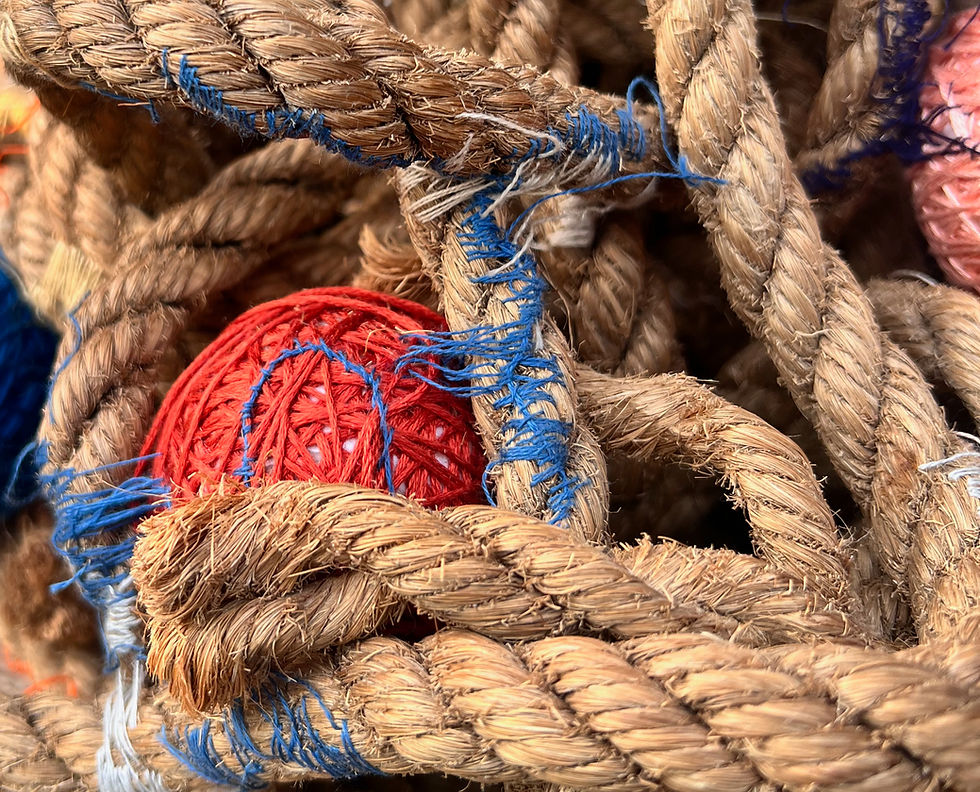
Threads became a very natural and instinctive material for me. The ways my mixed-media pieces are built feels obvious to me. They incorporate weave, beading and - believe it or not - the reverse-engineering of a sewing machine mechanism.
Now, building a new body of works, I've found myself focuing again on the thread - this time on rope, stitch and wrapping. I've been reading Tim Ingold's work on lines, and the thread feels like such a tangible way to think about relationships. This deserves its own post so I'll leave it there for now :)
Inspiration from the East
My dad travelled a lot for work when I was young. Every trip, he would bring something back for me and my brother. Being young, my favourite thing was a cuddly koala from Australia - who is still with me today. But most of his travels took him to East Asia, so also treasured from that collection of mementoes were silk paintings, woven fabrics, painted fans and parasols. As he travelled more, he'd bring back more treasures. I grew up surrounded by Japanese prints, Vietnamese fabrics, Indian miniatures.
When I was old enough, I travelled myself. I travelled to Japan to see the Cherry blossoms. I sailed down the Mekong river watching the islands disappear in the haze.
So when people tell me they see an Asian influence in my work, I'm not surprised. It's an aesthetic that I feel a deep kinship with, even though in the heart of my works I'm really just trying to find my way home, somewhere in the Kent suburbs.
The Thing with Wings
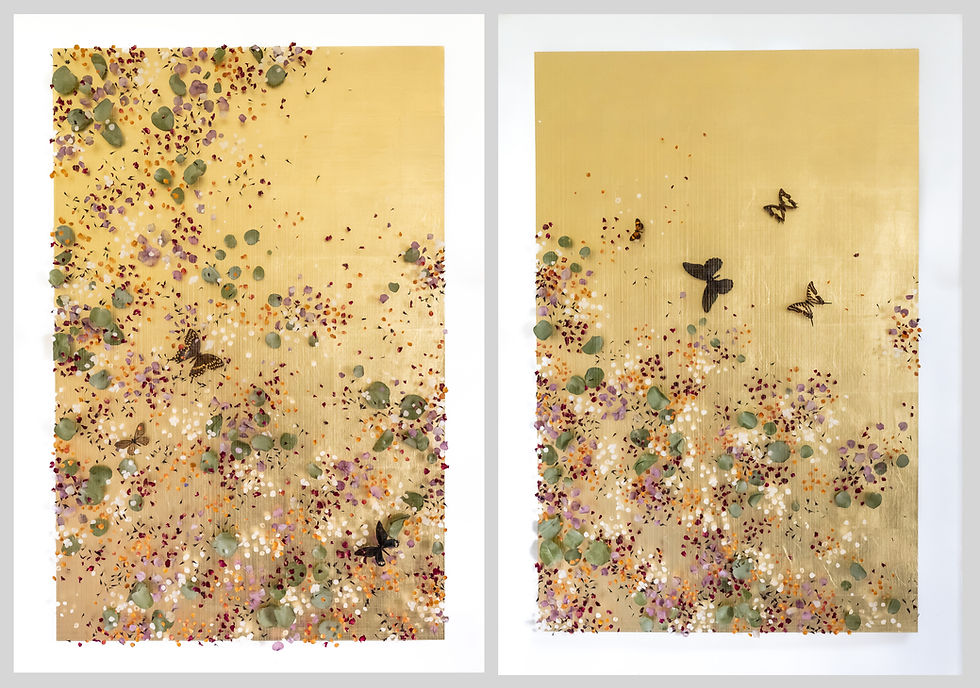
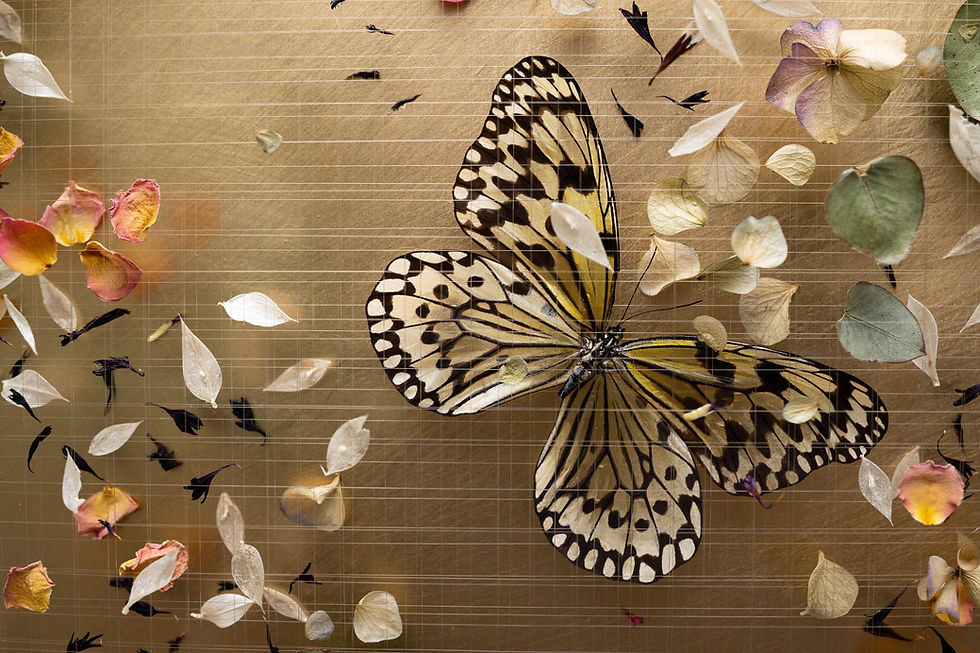
At the risk of painting a very odd portrait of myself as a child, if an eight year old could be considered an expert, I would have been a butterfly expert. I knew all the British butterflies by name, and I'd spend many a happy hour cross-referencing my finds with my ever-present i-Spy Book of Butterflies. I was drawn to the delicate magic of them. They reminded me of fairies, and the way they would catch the sun in a glint of colour and then disappear never failed to fascinate me.
As I learned more, I just became more fascinated with them. From the amazing construct of their wings, to the quite frankly disgusting process of metamorphosis, these creatures are amazing. And this fascination brings me back to my curious, full-of-wonder eight year old, who still half-believes in fairies and magic and happy ever after.
Bringing things together
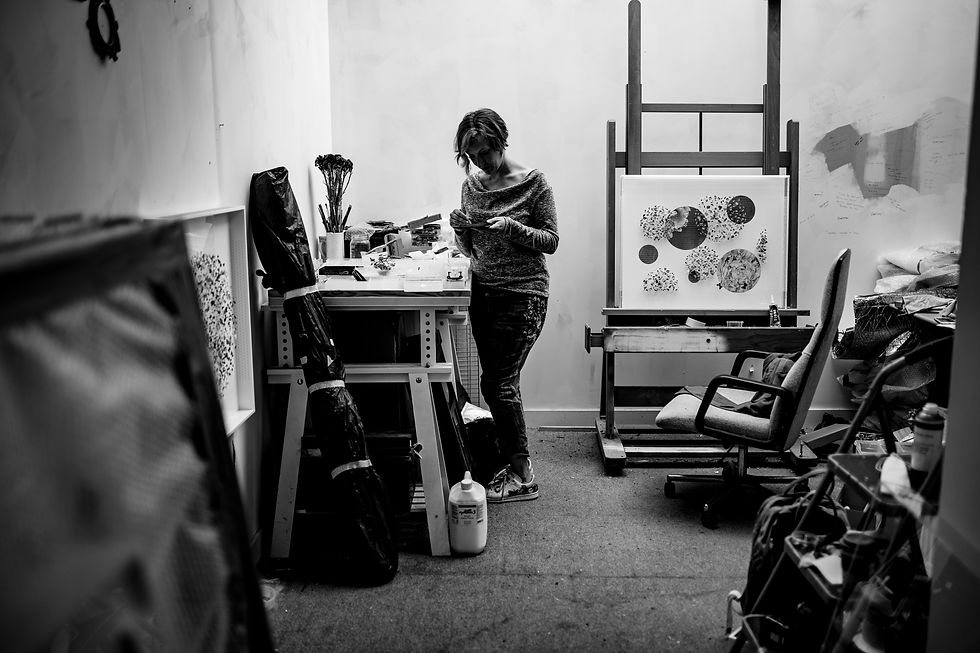
As my artistic practice develops, I find it easier to identify these through-lines that recur throughout my work. Sometimes the connections are obvious, sometimes they're obtuse, but it feels reassuring to return to these threads and find the new ways in which they interact. The interactions are messy and convoluted, and they continue to evolve. The further I get into the knots of the stories, the more I'm able to recognise the works as a self-portrait - of someone who's lost, incomplete, broken-hearted... and yet found, fulfilled and imperfectly repaired. And also still utterly, wonderfully confused.


Comments